Last week Indiana Disability Rights released its latest video in its voting series, How to Register to Vote. You should definitely check it out. Yours truly has a cameo role. 😉
Chicago Architectural Tour
I really dislike Chicago. It could be the wind, the cold, the inaccessibility, its politics, or some combination thereof. Up until last week, I would say that I hated Chicago. When I discovered I would be going to Chicago on a business trip (for RSA’s regional conference on the Work Innovation and Opportunity Act regulations), I predicted spending the majority of my time holed up in the hotel room, reading something on my iPad.
However, my sister decided to tag along. Despite having lived in the Midwest her entire life, she’d still never been to Chicago at the ripe old age of 25. Goal: Taking her to see the Bean. No reading for me.
After the obligatory photo session at the Bean, we decided to visit Navy Pier. We were thwarted twice, both occasions involving walking down long straights of sidewalk only to reach a curb at the end. As we made our way closer to the lake, I saw a kiosk for architectural boat tours. Were they accessible? No. The only place to load the boat in a wheelchair was at Navy Pier. On the bright side, the kiosk ladies directed us toward the most accessible pathway.
Despite the fact that boat tickets were more expensive at the Pier – $35 a ticket rather than $33 – I’m a nautical nut. If there is a boat ride available, I will find it – even in the middle of Arizona! (True story; ask my sister.)
The boat tour is frankly the reason why I no longer hate Chicago. I learned interesting facts about postmodern architecture, brutalism, and the Chicago Fire. Tour Guide Adam told us heinous stories about the Chicago River, including the fact that it was so filthy it lit during the Fire. He also explained that City officials rerouted the river, so that the filth would flow down to St. Louis rather than into Lake Michigan. (I guess I’m not alone in my dislike of Chicago…)
Anyway, I highly suggest the architectural boat tour for any fans of history, trivia, or boating. While they ramp was not ADA-compliant, it was easy enough for my power wheelchair to get on and off. Wheelchair seating was in a designated section, but was sufficiently spacious for me to turn around and look at buildings and bridges from all angles.
Fair Housing Legal Seminar Debriefing
On August 19, I attended the Fair Housing Legal Seminar sponsored by the Fair Housing Center of Central Indiana (FHCCI) and Indiana Disability Rights. The Seminar featured Professor Robert Schwemm of the University of Kentucky College of Law. Despite my biased perspective – I’m the Secretary of FHCCI and lead the employment practice group at Indiana Disability Rights – I think the Seminar was quite a success.
First, it’s important to acknowledge the great content imparted to attendees. Professor Schwemm not only provided a comprehensive overview of the Fair Housing Act and its amendments, but also tailored his presentation to the Seventh Circuit. Unlike typical continuing legal education classes, often delivered by current practitioners, the Seminar engaged in academic exercises to challenge participants and get them to consider the future of fair housing law. For example, participants discussed what may constitute a “dwelling” within the court’s consideration.
That’s not to say that the Seminar was merely an exercise in philosophical jurisprudence; Professor Schwemm shared stories about his time as a practitioner, garnering laughter with anecdotes of opposing counsel offering their client a defense on one count while accidentally conceding to having discriminated in other counts. Additionally, Seminar participants had the opportunity to watch videos illustrating the effects of housing discrimination on individuals and communities. One astounding video can be accessed here.
Second, I would be remiss if I did not mention the accessibility aspects of the Seminar. Five hours of continuing legal education credits were offered for $35. Anyone who is attorney can recognize this is a great deal! The physical accessibility features were also much appreciated. FHCCI staff helped me gather all my paper materials upon arrival, and, along with an Indiana Disability Rights colleague, were happy to move tables so I could fit in the conference room in a location where I would not need to move my head to see the speaker/video screen.
I encourage anyone interested in getting involved in fair housing to consider attending the Annual Fair Housing Conference on April 6, 2017!
Live and Let Die? No Way!
You might have read the story of Jerika Bolen recently. I know my friends in the disability community have been trying to reach her and share their stories and resources. Unfortunately, it seems that the media and much of the non-disabled world is ready to say goodbye to her – and even facilitate her death.
According to the story, Jerika is 14 years old with SMA, Type II. Although the writer characterizes SMA as “an incurable disease,” many technological advances have made it possible for people with SMA to live productive, fantastic lives. I know this because I have the same disorder.
Jerika has expressed a desire to withdraw medical support. In her case, a ventilator helps sustain her life. She has apparently asked for the provision of morphine and the withdrawal of the ventilator so that she can pass away. Her mother – her natural guardian – has assented, and the death is planned for the end of the summer. I’m hoping someone intervenes.
I understand that SMA affects everyone differently. My sister has the same disorder, and we both have different medical concerns. One of mine, as in Jerika’s situation, is chronic pain. It took me more than a year before I found a doctor that was willing to work with me and identify means of managing the pain. That year was incredibly difficult; when I felt pain, I couldn’t focus on work, and when I didn’t feel productive, I felt useless. Relatedly, Jerika has indicated that she doesn’t like taking her pain medicine because it puts her to sleep. Alternating between sleep and homework makes her life dissatisfactory, she says; in effect, the pain is controlling her.
Obviously, I can’t speak to the degree of Jerika’s pain nor the treatments she has tried. However, I want to encourage her to keep looking for treatment solutions. Something tells me that waiting until one’s pain hits a “9” or a “10” is an ineffective strategy for managing chronic pain. Perhaps a new specialist is in order.
The other major issue to address is the fact that Jerika is a minor at 14 years of age. (Remember Julianna’s story?) Yes, 14-year-olds should definitely have input into medical matters. But input is distinct from decision-making capacity. I will concede that Jerika likely knows more about SMA than many of her physicians. But at 14 years of age, Jerika doesn’t know what the future holds or much of life beyond childhood.
I was miserable as a teenager. I think many kids are. But able-bodied children are taken to counselors to get their issues addressed. Why is it that kids like Jerika are simply handed a bottle of morphine? The sad fact is that society devalues the lives of people with disabilities, of people like Jerika, of people like me.
Many outside of the disability community who have weighed in on this story have attempted to frame the issue in terms of respect for autonomy. This argument is disingenuous; a 14-year-old child does not have the legal capacity to make autonomous decisions in America. Respect for Jerika should be demonstrated as respect her life.
American (Unf)Airlines
If you read any mainstream newspapers or blogs regularly, you’ve probably read at least one story about the horrors of air travel for people with disabilities. Not too long ago, I shared my own experiences with TSA in a blog for the MDA Transitions Resource Center. A The latest transportation entity on my shit list? American Airlines.
Saturday afternoon, I left for Reagan National to attend a housing conference. (More on that later.) Usually I fly Southwest, but no flights were available when I needed to arrive. Alas, American was my only option. Maybe next time I’ll just stay at home instead…
A quick explanation of procedures for those not familiar with the disabled boarding process: I’m not allowed to bring my wheelchair onto the passenger area of the aircraft. Airlines require that I be transferred at the end of the jetway. In regard to who carries me to the aisle chair, I have no choice – it’s whoever the airline sends. The type of training – if any – that these staff members receive is beyond me. Nonetheless, I am entirely at their mercy. Then, different staff members come to the end of the jetway, and whisk my wheelchair away to the underbelly of the plane. I am strapped into the aisle chair, taken down to the bulkhead, and transferred to the aisle seat. Nerve-racking is an understatement.
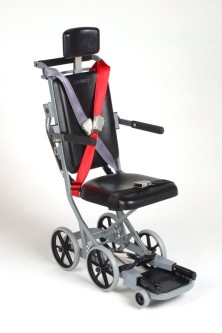
On Saturday, we got to the airport early and asked the check-in woman if she could go ahead and tag my wheelchair and transfer us to the bulkhead. Unlike Southwest, the check-in woman stated all accommodations need to be granted by the gate agent. So we proceeded to go through TSA. Fortunately, my inspection went rather quickly and the agent didn’t even pat me down – just my wheelchair. My experience with the gate agent was not so fortunate.
The gate agent stated that she wasn’t sure whether we could be moved to the bulkhead. Something about people paying extra for bulkhead seats. Nevertheless, after I explained that it is difficult to get me into the airplane seat given the four people involved in the transfer and cramped space, the gate agent promised to see what she could do.
The gate agent never followed up with me, so I figured everything was good to go. However, I was shocked to learn – only after I was strapped into the aisle chair – that we were stuck in seats 11A and 11C. Those seats were almost the very last in the plane! Apparently the gate agent told my mom that the people in the bulkhead paid a premium for their seats and were unwilling to move. Funny that she didn’t have the courtesy to deliver the news to me.
As the transferers pulled me backwards down the aisle, my butt and stomach began to scrape against the seats on either side. The sling that I sit on to transfer was also getting caught on the seat armrests and ripped. When staff realized what was happening, the man behind me would immediately stop pulling the chair, causing the woman holding my arms to step on my toes. It was painful, but they acted oblivious. Three aisles back, someone from Baggage stepped onto the plane and said it was ridiculous that I was not sitting in the bulkhead. No shit, Sherlock. My mom explained that the gate agent denied my request for accommodation, and though the baggage person kept talking about the ridiculousness of the situation, no intervention was made on my behalf.
Even after I got on the plane, I still wasn’t good to go. Baggage couldn’t get my wheelchair onto the plane. Staff told me they would tip it sideways and see if that worked. I told the baggage handler not to tip my wheelchair on the side with the joystick. Then they gate agent boarded to inform me that if my wheelchair didn’t fit on the plane, I would have to deboard and wait for a different flight. Approximately one hour after the scheduled time of departure, we finally took off for DC.
My reception upon arrival was similarly demeaning. A single man came to help me off the plane after everyone else left. Without even talking to me, he bent down like he was going to try to move me. I said, “No,” and my mom explained how to transfer me with the sling. We also explained that more people were needed to safely do the transfer. He ignored us, and grabbed the sling in a place that would be completely useless. Again, my mom tried to explain that we needed more help. He ignored us, but a woman finally joined him. They transferred me to the aisle chair. I started to slide, and stated that I needed to move backward. My mom lifted the sling to offer it to the man, but he said he was going to pick me up under the arms. I said I could not do this, and he told me I could. My mom put her arm over me to stop him, and the woman eventually got him to listen.
You might think that was enough for one day, but no. Because we did not land at a jetway, we had to take a shuttle back to the terminal. A fellow passenger was on the shuttle, and he started rudely talking about how waiting for my wheelchair to be loaded was an inconvenience. He suggested that I reschedule my flight home to avoid such delays in the future. To add further insult to the toe, stomach, and butt injuries, the guy who would’t listen to me on the plane tried to command my mom to drive my chair off the shuttle. Despite having witnessed me drive onto the shuttle, the man didn’t believe that I could safely exit it.
Once I got situated fully in my wheelchair, I realized it had been broken. More specifically, my left armrest was bent downward and no longer supported me. I was worried that I would fall over riding to the hotel on the Metro. So we stopped at the baggage claim area and explained the problem. The baggage claim woman stated that we would have to file a formal complaint. My mom stated that she could fix the armrests if given an Allen wrench. Three times the woman denied this request and said the only way to get my wheelchair fixed was filing a complaint. Fortunately, someone overheard, had mercy on us, and found someone with an Allen wrench. However, our helper informed us that if the airline knew what was happening, it would have the helper’s head. Abso-fucking-lutely ridiculous.
But it gets worse, friends. I had to return home on Tuesday.
Although my mom and I had no intention of booking a different flight, we did get to the airport super early in order to arrange for necessary accommodations. We approached the gate agent, she glanced at our tickets after ignoring us for several minutes, and mumbled something indecipherable. “What?” my mom asked. “Over there! Indianapolis!” the woman barked, nodding toward Gate 39.
We walked to Gate 39, but that was for a flight leaving Indianapolis at 3:30 PM. We were set to leave at 4:45 PM. My mom asked the new gate agent if our flight had been moved, and she acted as if we were crazy. Our boarding passes clearly said Gate 41. Was there anything this gate agent could do for us, my mom asked. She was shut down.
So we made our way to the Customer Service desk. Its staff indicated that no gate agent can help a passenger unless it was 30 minutes or less until the flight was scheduled to board. We explained that we needed to get things in order before the flight, especially since disabled people board first, but were told nothing could be done. As we waited another hour, our gate was changed again.
The new gate agent was a friendly man, but he was immersed in the details of the current flight and could not help us. He asked us to wait to the side of the desk, and my mom told him that was fine, provided we would be first in line for assisting passengers on the Indianapolis flight. He agreed. Then the airline called him to a different gate, leaving ours unstaffed. I waited in front of the desk for another 15 minutes or so before another man came to the gate. He just ignored me. It was not until my mom returned from going to the bathroom that he began speaking with her.
He stated that bulkhead seats are premium, so he could not move us. My mom asked if there was anyway we could be moved to the second row, so that I wouldn’t have to be pulled all the way back through the plane again. The gate agent literally walked away without responding.
Oddly, a different guy walked through and stated that someone from baggage would be coming to learn how to take care of my chair. My mom and I asked about getting our seats changed and getting help for transferring, and the man said we would have to work with the gate agent. When a gate agent came back, we tried again. He ignored me again. He wouldn’t even look at me, so I began to state in a raised voice that I needed to speak with someone about reasonable accommodations!
The man who was concerned with Baggage returned, and my mom attempted to intercept him before he left for a different gate. He talked to the gate agent, and said that the airline could do nothing to move us to different seats. Keep in mind that not only were my mom and I not sitting in the bulkhead – we were not even sitting in the same row! I cannot hold my head up on an airplane seat, let alone keep my body in the chair during landing. We explained all of this, but were told that nothing could be done. The man who is not the gate agent shouted to everyone waiting at gate that my mom and I would like to sit together, and the airline would accept volunteers to let us do so. He never explained why the request was made (aside from pointing us out in front of everyone), but he was sure to let everyone know moving was completely optional. It was humiliating, and I was terrified about what would happen to me.
A few minutes later, the man came back and said that I needed to board the plane. No one had come from Baggage. No one had told me that my seat had been moved. Somehow, miraculously, and without any volunteers, the gate agent managed to transfer us to the bulkhead, together. Why he couldn’t do this earlier is beyond me.
We waited for everyone to board. Then we waited to taxi to the runway. Then we waited longer. Then we waited more. Then we were told that we were going to be waiting a lot longer, as our flight was in the path of a storm.
Initially, we were given updates every half hour or so. Then the updates stopped until we were informed we needed to refuel. Cleverly, it was then that the airline decided to give us pretzels and the glass of water. This was about at the two-hours-of-waiting mark. We should have landed by then. In fact, I was counting on having landed by then.
My two major reasons for not enjoying flying – aside from having to deal with airline staff – are pain and not being able to go to the bathroom. I took appropriate pain medication for a two hour flight, and my back was starting to feel the agony. I also had not gone to the restroom since approximately 7 AM that morning. I thought I would be able to pee by 9 PM at the latest. Wrong, and my bladder was starting to get angry about it. Nevertheless, airplane bathrooms are so tiny, I cannot use them. I believe most domestic flights carry an aisle chairs, but the stewardess never offered me one. She never even asked if I needed any help, despite watching me wince and writhe. I begged my mom to signal the stewardess and ask if there was any way I could get off the plane, but my mom said we would have been informed if we were allowed to leave. In fact, we had repeatedly been told to keep our seatbelts on.
All told, I was on the plane for over six hours. Agony. If I can help it, I will never use American Airlines again.
Third-Place Team Still #1
This weekend, I headed to Fort Wayne, Indiana for the 2016 MK Battery Premier Cup. For those of you unfamiliar with power soccer, check out this awesome video (made by my sister/teammate) and the United States Power Soccer Association. My team, RHI Sudden Impact, finished third.
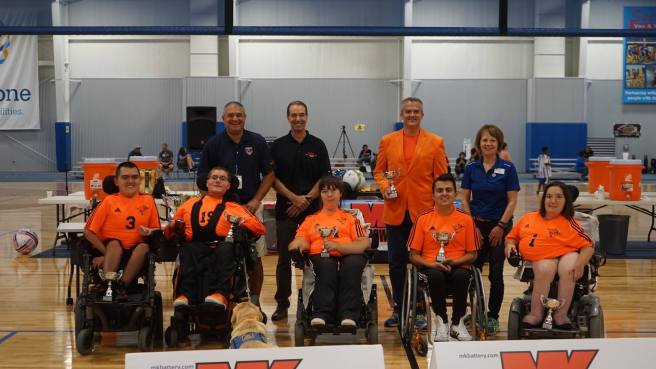
I know – why would such an awesome event be held in Fort Wayne, of all places? In the past, we’ve gotten to travel to Tampa, Phoenix, or at least stay in Indianapolis. There is one cool thing I can say about Fort Wayne, though. The Plassman Athletic Center has power soccer courts. That’s right – the court markings are actually inlaid!
Another awesome fact? I got to use a Strike Force wheelchair for the first time! In the photo above, one of my teammates, Emmanuel, is missing. (Apparently he got a better offer and traveled to Virginia Beach to celebrate high school graduation.) So I got to use his $8000 sporting chair and spin myself dizzy. Suddenly, the sport became much, much more fun!
I’m looking forward to next year, where we will shoot for the championship. Aside from how awesome it was to win my first power soccer trophy after approximately a decade of playing, my hilarious teammates and coach definitely make RHI Sudden Impact #1 for me!
Dear(ly Departed) Julianna
My heart is broken. Many of you are familiar with the awful tragedies that have affected Orlando as of late – an absolutely horrific terrorist attack at a gay nightclub and a boy killed by an alligator at Disney World. But the death of Julianna Snow also occurred recently, going largely under the radar.
You may have heard of Julianna, the five-year-old girl who media outlets portrayed as choosing “heaven over hospital” in the event she got sick again. I, and many of my friends with neuromuscular disabilities, felt a special kinship with Julianna. She, too, shared a neuromuscular disorder that involved use of a wheelchair and respiratory therapy. (She also believed one could never have too much glitter, which I personally feel is a great motto.) News coverage and the underlying news item – that Julianna’s parents would allow a child so young to refuse life-saving measures – concerned us deeply.
Aside from personal views, the item was probably deemed “newsworthy” because it diverges from bioethical and medico-legal norms. Under American jurisprudence, one must give informed consent to treatment. Similarly, one needs capacity in order to exercise the right to make autonomous medical decisions. Traditionally, and as practiced by the American Academy of Pediatrics, whether or not minors can give consent is governed by the Rule of Sevens. That is, children younger than seven lack the capacity to make medical decisions; children ages seven through 13 have sufficient autonomy to be consulted in decision-making processes; and children ages 14 and above are sufficiently developed to participate heavily in the decision-making process. Keep in mind that Julianna’s parents surrendered decision-making authority to her at age five.
I don’t doubt that Juliana’s parents cared for her. Their compassion is evident in family video. But Juliana’s parents were heavily influenced by the medical model of disability; her mother is a physician. Because doctors cannot cure disability, they tend to be baffled by it. In fact, physicians regularly underestimate the quality of life experienced by people with disabilities. And there is no doubt that Dr. Moon (Julianna’s mother) glorified heaven, describing as a place where Julianna could run and play
Are you beginning to see the problem? Even in a wheelchair, even with a ventilator, Julianna could have driven quickly enough to feel the wind blow through her hair and engaged in a bevy of joyous activities. To demonstrate the bright future awaiting Julianna, Emily Wolinsky launched the Dear Julianna Project, administered by NMD United, a peer-led advocacy group for adults with neuromuscular disorders. Many adults with disabilities – from around the world – wrote not only to Julianna’s family, but to the families of other diagnosed children, to share that the future is not doom and gloom. We have each had our fair share of hospital stays and unpleasant medical procedures, but we are also attorneys, artists, spouses, entertainers, volunteers, philosophers, and parents.
I often wonder whether Julianna had the opportunity to read any of our letters (or have them read to her, considering her age). Her parents were aware of the Project, and claimed it was “basically a slap in the face.” Again, Dr. Moon’s reaction shows a real failure to understand the disability perspective.
I hope you are happy in heaven, Julianna, but I don’t care whether you remain in a wheelchair. It need have no bearing on the enjoyability of one’s existence.
The author wishes to disclose that she is a participant in the Dear Julianna letter-writing campaign, and also contributed financially to it.
Lame Symbology
I feel like Peter Griffin when I say that the Accessible Icon Project really grinds my gears. Of course, I actually do have gears, riding around in a wheelchair and all…
So what is this Project of which I whine? If you are not a hermit – and maybe even you are – you should recognize the International Symbol of Accessibility (ISA).  Most commonly, this symbol isused to mark handicapped parking spaces, but it also indicates the presence of other accessible design features for people with disabilities. It features a stick figure sitting on a wheel. Pretty standard… It does the job, and has been doing it for nearly 50 years!
If it ain’t broke, I say, don’t fix it. After all, people with disabilities have enough things to worry about. Is a symbol really worth launching an entire movement?
Apparently Sara Hendren and Brian Glenney think so. In 2009, the two began graffiti-ing ISA symbols in New York City. The new design purports to show people with disabilities as more than mere stick figures, but rather active, engaged participants in community life. The Accessible Icon Project was born, and some disability activists began stickering or lobbying campaigns of their own to get the new symbol more widely adopted.
At this point, I imagine you might be wondering why someone who purports to be a disability activist herself would be irritated by the new depiction of accessibility. Because the new symbol prioritizes physical activism. The new symbol is still a disabled stick figure in a wheelchair. The difference is that the stick figure is now pushing itself in a manual wheelchair.
Certainly, the visual alteration is minor. But the message is not. To argue that the new symbol is “better” than the ISA is to determine that having the ability to physically steer oneself is better than alternate means of direction. People with disabilities should be concerned about philosophical and actual self-direction – which still have not been achieved by far too many – not physical propulsion. Essentially, the new symbol is ableist.
I had not thought about the new symbol until I spent the weekend in New York. I was visiting Siena College and happened to park in a space marked with it. I had forgotten that New York became the first state to require that the ISA be replaced with the new symbol. As a person with a disability, legislation like that frustrates me even more. Instead of mandating that people with disabilities should have equal access to home and community-based services, legislators are wasting time paying lip service to politically correct iconography. (And people wonder why Trump is doing so well in the polls!)
Moreover, I don’t think it’s fair to ask businesses to replace the existing universal symbol of accessibility in favor of the latest fad. It costs money. While I do believe that businesses have an obligation – morally, in addition to legally – to make reasonable accommodations for customers, I think it is short-sighted to ask them to pay for alterations that make no substantive difference to disabled people. If business owners are passed off, I don’t blame. But I do worry that they won’t be as receptive in the future to civil rights legislation that actually does make a difference.
Review: Crippled America
Yup. I did it. After weeks of hemming and hawing about whether I should read it, I finally picked it up. Blame it on the fact that I was stuck in a hotel room for four hours with nothing else to do or blame me for not resisting the title. Either way, I have digested Donald Trump‘s Crippled America: How to Make America Great Again.

As I recently joked in an MSNBC article, I was initially excited about the tome. Was a presidential candidate actually devoting an entire book to disability policy? Would we finally have a comprehensive long-term care program? New incentives for employers to hire people with disabilities? Of course, no such luck.
Crippled America is classic Trump. In fact, the first few pages of the book are actually devoted to discussing Trump’s portrait on the cover. He explains why he chose to scowl rather than smile. He also repeats things again and again and again – especially why he is a winner. But, if the reader can get past the self-praise with a few eye rolls, the book is not a complete bore.
Trump has received much criticism about his supposed lack of nuance and policy detail. Crippled America does answer some substantive policy questions. For example, readers learn which tax rates Trump would like to see enacted, in addition to the two tax loopholes he is in favor of keeping. Readers will also get a better understanding of Trump’s healthcare ideas (or admitted lack thereof). Trump explains that he has evolved from believing a universal payor system best, but is open to hearing from experts regarding what type of plan should replace Obamacare.
Because people should be voting in November, I do recommend they read this book to better understand Trump the candidate. I can’t say it’s “fun” or academically challenging, but it is important.
Competitive Drive?
Tomorrow marks the end of the National Mobility Equipment Dealers Association (NMEDA)‘s fifth annual Local Heroes Contest. Thank goodness! Why do I hate it? Let me count the ways…
- The name. We can get the obvious out of the way first. Local “heroes”? Clearly, the Association is referring to people with disabilities as heroes. It’s inspiration porn at its worst. The people, for the most part, entering the contest are regular, every day individuals that simply need some assistance with transportation needs. Being disabled does not equate to heroism.
- The design. You might say, “Well, Emily, some disabled people are heroes. What about the disabled vet who had his legs blown off in Afghanistan? What about the gal who tirelessly fought to expand independent living services in her county? Isn’t it great that the Association wants to get these people more mobile?” If only that were true… Instead, anyone can enter the contest. And the public at large votes for the top contenders. That’s right, my friend: the Association is merely sponsoring a popularity contest with the objective of getting its name out there.
- The private consequences. A new van generally costs around $60,000, depending upon the modifications required by each user. This makes it incredibly difficult for many people with disabilities to secure personal transport. I entered the contest the first year, not realizing what a disgrace it is. I quit promoting myself after I realized at the vast majority of my friends with physical disabilities also entered the contest. Social media feeds began to get nasty, with friends arguing one was more deserving another. Not something I wanted to be a part of.
- The public consequences. Absolutely nothing. Can the Association demonstrate how the contest has benefited people with disabilities in an overarching manner? I think not. More groups have not been created to lower the cost of accessible vehicles. Individuals are still struggling to make it to health appointments and work on a daily basis. The contest has done nothing other than result in vehicles for a few people, whose contributions are generally unremarkable.
I would encourage NMEDA members to quit supporting such a ridiculous endeavor. Time and money could better be spent creating sustainable programs that would support more individuals in accessing their own accessible vehicles. Why not start a low-interest car loan program? Why not offer smaller grants to people that are genuinely engaged in heroic pursuits that benefit the disability community? It’s high time the existing contest hit the road.
 Emily Munson